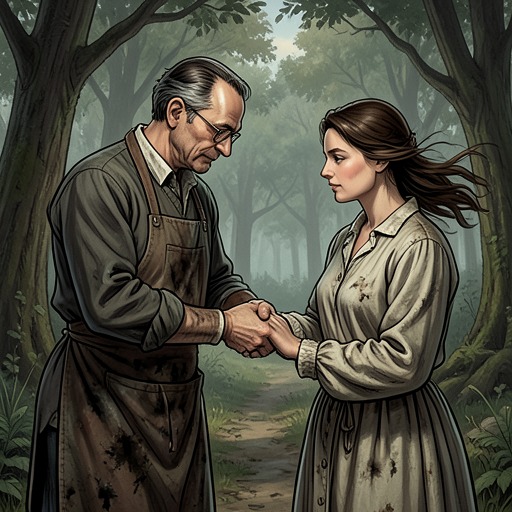
Goldmund’s nocturnal visit to the village
Narcissus and GoldmundGoldmund’s nocturnal visit to the village begins as a classmate’s invitation to break the rules, but becomes a turning point in Goldmund’s inner life: a brief encounter with a girl exposes the conflict between his expected monastic discipline and an attraction he cannot simply will away. Its aftermath also gives Narcissus the first opportunity to care for Goldmund, opening a new dimension in their relationship.
The invitation and the forbidden excursion
Goldmund has studied at Mariabronn for more than a year when Adolf approaches him during the recreation hour after supper. The two had first met in a fistfight and later studied Euclid together. Adolf asks Goldmund to promise not to tell the teachers about what he is planning. Goldmund gives his word, guided by the unwritten student code even when it conflicts with the monastery’s formal rules.
Adolf’s plan is to go to the village at night. Goldmund knows the phrase for these illicit outings and understands their appeal: the danger and secrecy make participation a mark of distinction among the regulars. He is tired, weak, and has had a headache, and initially wants to refuse. Yet embarrassment in front of Adolf and the possibility that the outside world might offer something new persuade him to join.
The monastery’s outer gate is locked, so Adolf leads Goldmund to the mill, where the noise of the wheels conceals their escape. They climb through a window onto wet planks and use one as a bridge across a stream. At the forest’s edge, they meet Konrad and later Eberhard; together the four walk through the night to the village. The excursion is at once a breach of discipline and an experience Goldmund finds exciting, distinct from the cloister’s ordered routine.
The meeting in the village
After less than an hour, the students reach a village that appears asleep. They move quietly around houses and through a garden before Adolf knocks at a shutter. A servant girl lets them into a kitchen, where a younger girl with long dark braids also appears. Adolf has brought gifts, including some white bread from the cloister, and the group shares apple cider from a clay jug.
The boys talk in whispers. The others exchange tentative gestures of affection with the servant girl, while no one touches the younger girl. Goldmund sits apart, silent and fixed on the lamp, trying to forbid himself from looking at the girl with the braids. He believes that he is destined for the ascetic life of a monk and regards even this visit as sinful. Yet whenever his attention strays toward her, he finds her dark eyes already fixed on him. The encounter’s significance lies less in anything the students do together than in the mutual attention Goldmund cannot suppress.
When it is time to leave, the students say goodbye to the girls in turn. As Goldmund climbs out of the window, the younger girl holds him back by the shoulder. She calls him by name, asks whether he will come back, and urges him to do so with a kiss. Goldmund leaves the garden and follows the others toward the forest. His will insists that he must never return, while his heart immediately longs to go back the next day. The moment gives the secret excursion a personal consequence that the other students’ brief adventure does not have for him.
The return and its immediate cost
The four boys make their way back to Mariabronn by the same concealed route, crossing the stream and passing through the mill before returning to the dormitory. The following morning they attend the usual services and lessons, but Goldmund looks so pale that Father Martin asks if he is ill. Adolf warns him not to disclose their outing, and Goldmund says he is all right.
During Greek, Narcissus watches Goldmund closely and recognizes that he is unwell. Rather than expose him in front of the other students, Narcissus sends him to the library on an errand and follows him there. He offers practical help, suggesting that Goldmund could be put to bed and given soup and wine if he is ill. Goldmund cannot explain himself. He leans against a lectern and breaks into violent weeping; Narcissus waits, then comforts him and takes him to the sickroom without passing the study halls.
The visit has left Goldmund worn down not by the walk through the forest or the mechanics of escaping the cloister, but by the effort to forget the girl’s question, her hands, and her kiss. His distress is therefore both physical and inward: the night has unsettled the identity he tries to maintain as a future monk. The tears release some of that strain. After eating some gruel, white bread, and red wine, he falls asleep, and the color returns to his cheeks.
Narcissus’s care and the event’s significance
Narcissus understands that Goldmund is not suffering from an ordinary illness. Seeing him asleep, he recognizes that the crisis has passed and that the encounter between them has changed their relationship. Until this point, Narcissus has guarded himself against becoming too close to Goldmund, believing that friendship could threaten his dedication to serving the mind and guiding pupils. Now Goldmund has needed his help, and Narcissus sees the possibility that one day he too might be able to accept care and affection from the younger man.
The event thus joins two kinds of awakening. In the village, Goldmund experiences an attraction that conflicts with the ascetic vocation he believes is expected of him; back at the monastery, he discovers that his apparent weakness can bring him into a more intimate relation with Narcissus. The girl’s brief invitation remains unresolved, held between Goldmund’s command never to return and his heart’s contrary desire. The emotional aftermath, however, has a clear consequence: Narcissus and Goldmund move toward friendship through a moment of distress rather than through scholarly achievement.